X-ray technology supports several types of medical examinations, but not every imaging procedure requires the same approach. Some examinations need a single image of an anatomical structure, while others require continuous visual information to understand movement inside the body.
This is where digital radiography and digital fluoroscopy serve different purposes. Although both technologies use X-rays, their image acquisition methods and clinical applications are not the same.
What Is Digital Radiography?
Digital radiography, commonly called DR imaging, uses electronic detectors to capture X-ray images.
When an X-ray exposure is made, the detector receives radiation that has passed through the patient’s body and converts it into electronic information.
The resulting image is processed and displayed on a workstation.
DR imaging is commonly used for examinations involving:
- Chest and lung structures.
- Bones and joints.
- Spinal alignment.
- Certain abdominal examinations.
- General skeletal imaging.
The technology allows images to be reviewed digitally without the chemical development process required by conventional film.
What Is Digital Fluoroscopy?
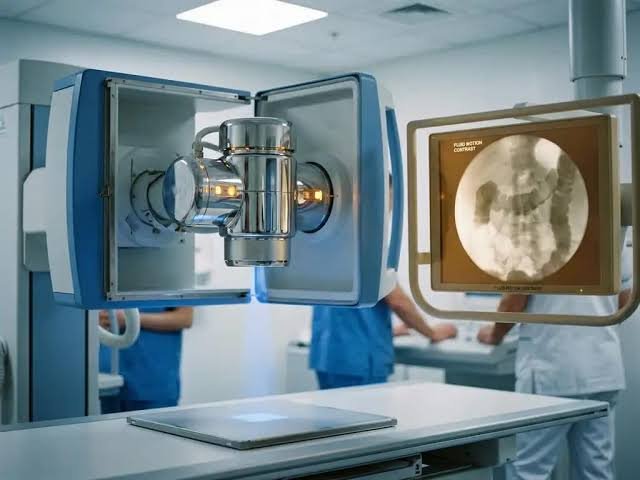
Digital fluoroscopy is an imaging technique that produces a sequence of X-ray images to show movement in real time.
Instead of capturing only one static image, the system displays a series of images that allow healthcare professionals to observe internal structures during movement or while contrast material passes through the body.
Common applications include:
- Barium swallow examinations.
- Gastrointestinal contrast studies.
- Certain swallowing assessments.
- Evaluation of joint movement.
- Image guidance during selected procedures.
Modern fluoroscopy systems may use pulsed X-ray operation and digital image processing to support image acquisition and radiation management.
Digital Fluoroscopy vs DR Imaging
Although the technologies share the same underlying use of X-rays, their purposes are different.
| Feature | Digital radiography | Digital fluoroscopy |
| Image type | Individual static images | Sequence of images |
| Main purpose | Anatomical assessment | Visualising movement |
| Image acquisition | Individual exposures | Continuous or pulsed imaging |
| Typical applications | Chest and skeletal imaging | Contrast studies and procedural guidance |
| Workflow | Capture and review | Real-time observation and recording |
Neither technology is universally better. The appropriate system depends on the clinical question being investigated.
Understanding Digital Detector Technology
A digital detector is a key component of modern X-ray imaging systems.
In digital radiography, flat-panel detectors commonly capture X-ray information and convert it into an electronic signal.
Detector technology can influence image quality, sensitivity, positioning flexibility and workflow.
Fluoroscopy systems may use specialised detector arrangements suited to their real-time imaging requirements.
The detector must be compatible with the system’s acquisition and processing technologies.
The Role of DR Radiology Solutions
Modern DR radiology solutions include more than image-capture equipment. They combine detectors, X-ray generators, acquisition software, image processing and digital communication systems.
An imaging department may also use PACS for storing and retrieving examinations.
The integration of these components helps organise imaging workflows and makes digital images accessible to authorised healthcare professionals.
What Should Healthcare Facilities Consider?
When evaluating imaging equipment, facilities should begin with their clinical requirements.
For general skeletal and chest examinations, digital radiography may be appropriate. Departments performing procedures that require real-time imaging may need fluoroscopy capabilities.
Other considerations include:
- Expected examination volume.
- Image quality requirements.
- Radiation protection.
- Equipment compatibility.
- Room design and available space.
- Maintenance and technical support.
Choosing Technology According to Clinical Needs
Digital radiography and digital fluoroscopy are complementary technologies rather than direct replacements for each other.
Understanding their differences helps healthcare facilities select equipment according to the examinations they perform.
A well-planned imaging environment should focus on clinical requirements, suitable detector technology and reliable integration across the radiology workflow.